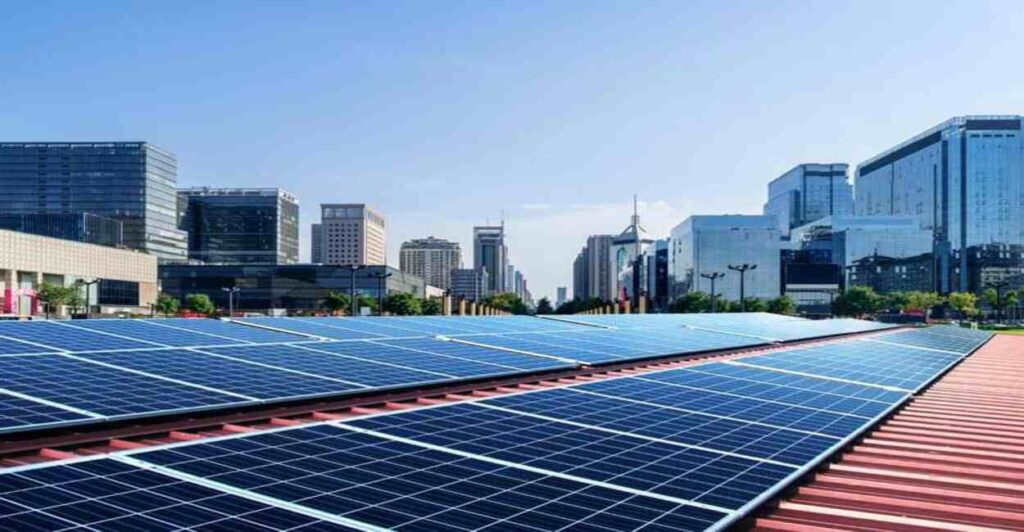
Let’s be honest — no business runs without power. From heavy manufacturing units to data centers, electricity is the lifeline that keeps operations alive. But for most industries, it’s also a silent burden — unpredictable tariffs, outages, and environmental pressure.
So when we talk about solar for industries, we’re not just talking about panels and sunlight. We’re talking about financial stability, brand responsibility, and long-term vision.
Why More Industries Are Turning to Solar
There’s a reason solar energy is no longer a niche investment. Industrial users are realizing that every kilowatt generated from the sun is a rupee saved — and a ton of carbon avoided.
Here’s why it’s gaining traction fast:
- Energy cost control: No surprises on your utility bill.
- Better ROI: Payback within 4–5 years and decades of savings ahead.
- Green branding: Sustainability isn’t optional anymore — it’s expected.
- Operational resilience: Power backup and hybrid setups reduce downtime.
When you add it all up, solar isn’t an expense — it’s an upgrade.
India’s Industrial Energy Revolution
India’s industrial energy landscape is changing faster than ever.
According to MNRE reports, industries now contribute to nearly half of solar adoption under commercial-scale projects.
From cement factories in Gujarat to food-processing plants in Telangana, solar adoption is becoming standard practice. And it’s not just the big conglomerates — even SMEs and regional manufacturing hubs are switching to solar to cut energy costs and attract ESG-focused investors.
How Solar Works for Industrial Needs
Industrial energy demand is complex — different shifts, different loads, different peak hours.
That’s why solar for industries isn’t one-size-fits-all.
Altisun Solar designs tailor-made solar systems that factor in energy usage patterns, shadow analysis, and structural capacity. Whether rooftop, ground-mount, or hybrid with battery storage — every system is built for performance.
And the best part? Real-time monitoring tools let businesses track performance, detect faults, and measure savings on the go.
The Financial Case — More Than Just Savings
Numbers don’t lie.
Industrial solar systems typically cut power expenses by 30–50% annually. Over 25 years, that translates to crores in savings.
Add government incentives — like Accelerated Depreciation (AD) and net metering — and the ROI becomes even more compelling.
Think of it as buying your next 20 years of electricity at today’s rates.
Beyond Economics — The Green Edge
In today’s market, sustainability sells.
Customers, investors, and supply-chain partners all want to associate with responsible brands.
When your factory runs on sunlight, it tells a powerful story — one that builds trust and opens new business opportunities.
Companies in sectors like FMCG, automotive, and textiles are already using solar adoption as part of their brand identity. It’s not just good for the planet; it’s great for PR.
Altisun Solar — Powering India’s Industries Responsibly
At Altisun Solar, our mission is simple: help industries achieve energy independence.
We provide comprehensive solar solutions for businesses — from site audit and design to installation, monitoring, and maintenance.
Our engineers use top-grade panels, smart inverters, and sturdy mounting systems built for Indian conditions.
Altisun clients also get access to an intuitive performance dashboard, giving complete visibility over generation, savings, and environmental impact.
It’s solar made simple — and smart.
Challenges? Sure. But They’re Manageable.
Yes, industries often worry about roof load, maintenance, or weather resilience. But here’s the thing — these challenges are solvable with expert engineering.
Modern panels are lightweight yet durable, capable of handling monsoon winds and summer heat.
With minimal cleaning (often just rainwater), they stay efficient for decades.
So no, solar doesn’t “complicate” operations. It simplifies them.
The Road to a Sustainable Future
India is walking the talk on renewables — and industries are leading the charge.
By 2030, over 50% of India’s total installed capacity is expected to come from renewable energy.
For businesses, this isn’t just a compliance move. It’s the foundation of future competitiveness.
When energy costs are predictable and sustainability is visible, growth becomes sustainable — in every sense of the word.