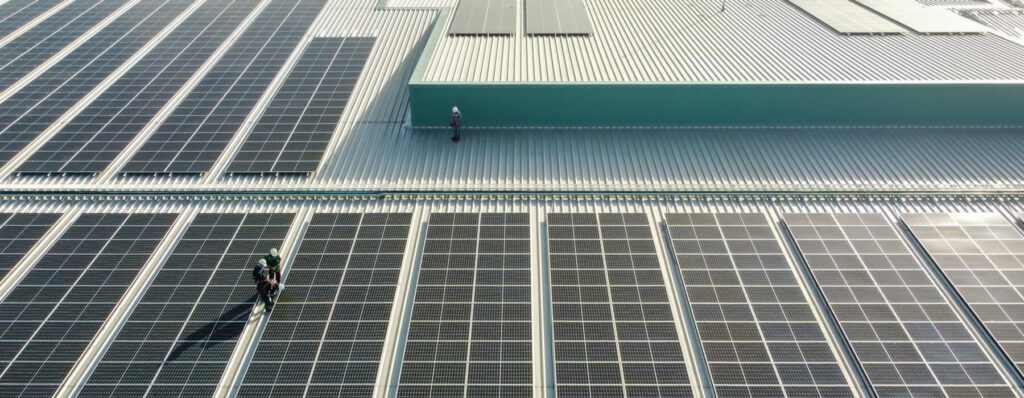
Your Factory Roof: The Most Undervalued Asset
Every industrial building has one — a vast, open rooftop that mostly collects dust and sunlight.
But what if that same roof could generate electricity, slash your bills, and boost your brand’s green credibility?
That’s the potential of industrial solar rooftop systems — turning unused real estate into a long-term financial and environmental advantage.
From Roof to Powerhouse
Industrial rooftops are practically begging to go solar. They’re large, strong, and often unshaded — ideal for solar panel installation.
With the right engineering design, those panels can meet a significant portion of your daily power demand, especially during daylight manufacturing hours.
And since most factories consume power when the sun shines brightest, the generation-to-consumption ratio is incredibly efficient.
It’s as if solar was made for industry.
The Economic Edge
Let’s talk numbers — the language every business understands.
A well-planned industrial solar rooftop setup can reduce electricity expenses by 40–60%, depending on the plant’s capacity and load pattern.
The payback period? Just 3 to 5 years.
After that, you’re generating near-free electricity for another 20 years.
And don’t forget the incentives — Accelerated Depreciation, Net Metering, and State Subsidy Schemes all improve ROI further.
Solar isn’t just sustainable — it’s sound economics.
How It Works (Without the Tech Overload)
Here’s the short version:
- Solar panels absorb sunlight and create DC power.
- Smart inverters convert it to usable AC electricity.
- Energy meters and monitoring software track generation, savings, and grid exports.
- Any excess power goes back to the grid through net metering, reducing your next bill.
Simple, automated, and remarkably reliable.
Why Industries Are Switching Fast
The trend is clear — India’s industrial clusters are going solar at record speed.
From Chennai’s automotive belt to Surat’s textile hubs, rooftops are gleaming with panels.Why? Because it’s a win-win situation. Businesses save money, reduce carbon footprint, and meet compliance requirements — all at once.
And in an age where ESG (Environmental, Social, Governance) scores influence investments, solar rooftops have become a silent yet powerful marketing tool.
- Smart inverters convert it to usable AC electricity.
- Energy meters and monitoring software track generation, savings, and grid exports.
- Any excess power goes back to the grid through net metering, reducing your next bill.
Simple, automated, and remarkably reliable.
Overcoming the Usual Concerns
Many industries hesitate at first — “Will my roof handle the weight?” or “Will it disrupt production?”
Reasonable questions, but easily addressed.
Altisun Solar conducts detailed structural assessments before installation, ensuring your roof’s safety.
Our engineers use lightweight yet durable mounting systems suitable for any roof type — metal sheets, RCC, or curved structures.
As for disruption? Practically none. Installations are modular and fast, completed without halting your operations.
The Sustainability Multiplier
The beauty of solar energy goes beyond savings. It’s about transformation.
By adopting industrial solar rooftop systems, you’re directly contributing to India’s renewable energy goals and global climate commitments.
For every megawatt-hour of solar energy your factory generates, you prevent nearly 700 kg of CO₂ emissions — a tangible difference for the planet and your brand reputation.
That’s real impact — measurable and meaningful.
Why Altisun Solar is the Preferred Choice
At Altisun Solar, we understand the industrial mindset — precision, efficiency, and reliability.
That’s exactly how we design our rooftop solar systems.
Our process includes:
- Detailed site surveys and feasibility studies
- Custom energy system design
- Use of Tier-1 solar panels and high-performance inverters
- 24/7 remote monitoring and maintenance support
We’ve powered textile units in Tamil Nadu, steel manufacturers in Maharashtra, and agro-processing facilities in Karnataka — each saving lakhs in electricity costs.
Simply put, we build systems that pay for themselves — and then some.
The Future Lies Above
Imagine driving past an industrial area where every rooftop glints with solar panels.
That’s not wishful thinking — it’s the next chapter in India’s energy revolution.
As power tariffs rise and sustainability demands intensify, rooftop solar will shift from an option to an obligation.
The question is, will your business be ready — or catching up?